Elettaria cardamomum — one of the world's oldest and most prized spices. Cultivated in the misty hills of Kerala and Karnataka, hand-picked and graded from 6mm to 9mm for global export.
Green cardamom (Elettaria cardamomum) is one of the most ancient and revered spices in the world. Grown in the misty hills of Kerala and Karnataka's Western Ghats, it has been a cornerstone of Indian trade for over 3,000 years.
Its distinct sweet, floral, and slightly minty aroma makes it irreplaceable in both sweet and savoury cuisines across the Middle East, Europe, Scandinavia, and South Asia. Cardamom pods are graded by size — the larger the pod, the more seeds, the more oil, and the stronger the aroma.
At Vyantra Overseas, we source green cardamom hand-picked from India's finest growing regions. Available in sizes 6mm through 9mm and also as hand-picked premium batches. All packaging is moisture-free vacuum-sealed to preserve essential oils.
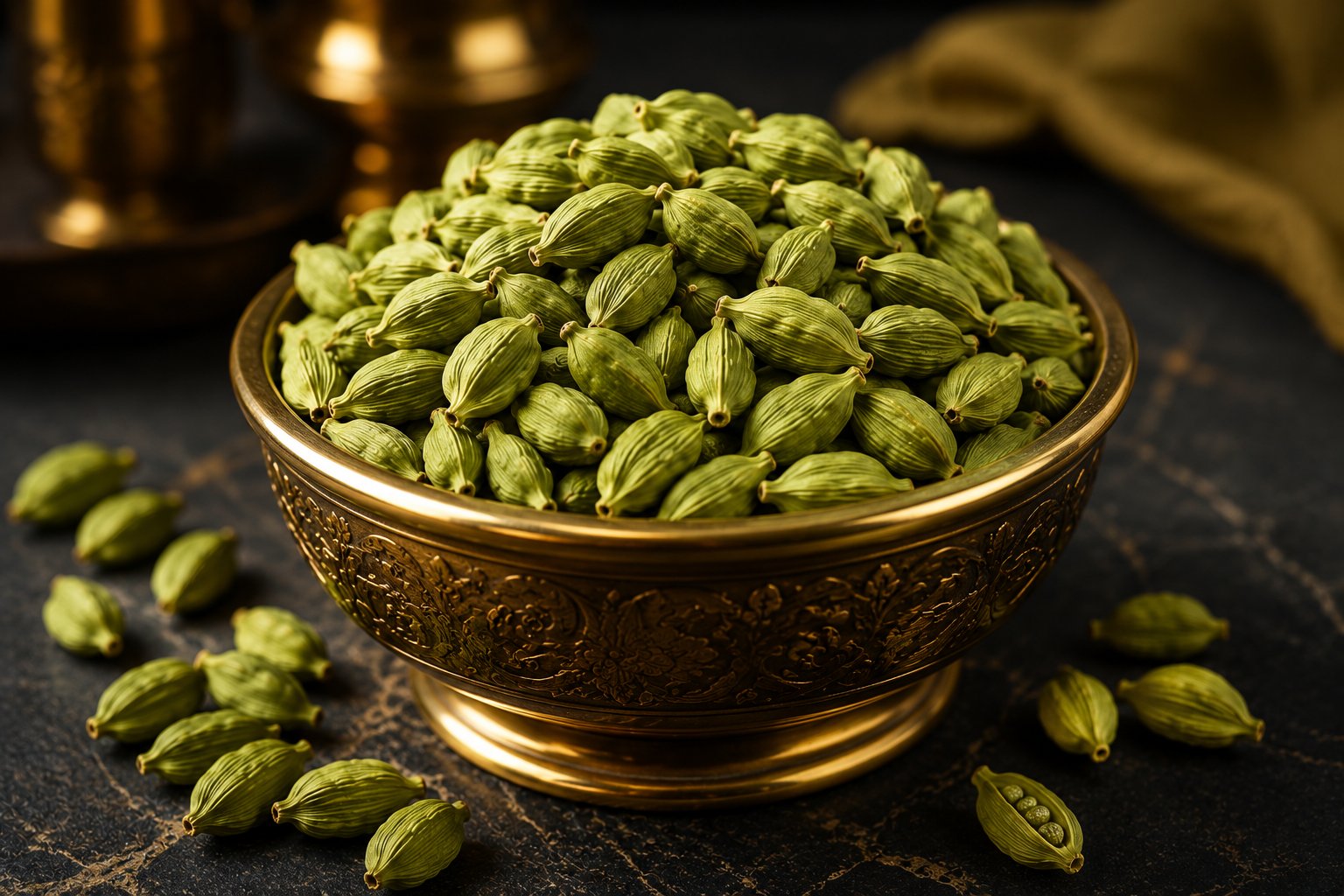
Green cardamom is internationally graded by pod size (diameter in mm). Larger pods contain more seeds, higher volatile oil content, and stronger aroma. The following sizes are what Vyantra Overseas supplies:
| Size Grade | Pod Diameter | Trade Name | Best For |
|---|---|---|---|
| 6mm | 6.0mm – 6.9mm | AGS — Alleppey Green Superior | Food processing, grinding, masala blends |
| 7mm | 7.0mm – 7.4mm | AGB — Alleppey Green Bold | Retail whole pods, food service, standard export |
| 7.5mm | 7.5mm – 7.9mm | AGB+ — Green Bold Plus | Premium retail, flavoured beverages, gourmet |
| 8mm | 8.0mm – 8.9mm | AGEB — Alleppey Green Extra Bold | Luxury retail, high-end food brands, premium export |
| 9mm | 9.0mm and above | Super Bold / Jumbo | Ultra-premium export, gift packing, specialty brands |
| Hand Picked | Mixed premium | Hand Selected | Luxury gifting, premium boutique brands |
* Size grades above are measured by pod diameter. Bigger pods contain more seeds and higher volatile oil content, producing a stronger aroma. All our cardamom is sortex-cleaned, hygienically processed, and moisture-protected. Source: International cardamom export trade standards.
Backed by both ancient Ayurvedic tradition and modern research, green cardamom offers a wide range of wellbeing benefits. The following are general wellness associations — not medical claims.
Cardamom has been traditionally associated with supporting healthy blood pressure and circulation. Rich in antioxidants that help protect cardiovascular tissues from oxidative stress.
The essential oils in cardamom — particularly cineole — are known for their antimicrobial activity. Long used as a natural breath freshener in Ayurvedic tradition.
Cardamom contains plant compounds associated with anti-inflammatory effects, traditionally used in Ayurvedic formulations for digestive and respiratory complaints.
One of cardamom's most ancient uses — traditionally consumed after meals to support digestion, ease bloating, and reduce nausea. Widely used in Ayurvedic medicine for centuries.
Cardamom's aromatic compounds are valued in aromatherapy for their calming, focusing properties. The scent has been associated with reduced tension in traditional wellness practices.
Used in Ayurvedic practice as an expectorant and to ease respiratory discomfort. A warming spice commonly combined with honey for traditional cough and cold relief.
The following reflects cardamom's role in Ayurvedic tradition and areas of ongoing scientific interest. This is for informational purposes only and does not constitute medical advice.
In classical Ayurveda, cardamom (Ela) is described as a tridoshic spice — said to balance all three doshas (Vata, Pitta, Kapha). Traditionally used for digestive fire, gas, heartburn, and nausea for thousands of years.
Some studies have explored cardamom's potential role in metabolic health. Preliminary research suggests possible effects on blood glucose — however, this area requires further clinical study and should not be interpreted as a medical recommendation.
Chewing cardamom pods after meals has been a widespread practice across South Asia and the Middle East for centuries as a natural way to freshen breath and support oral hygiene.
In Ayurvedic texts, cardamom is classified as an expectorant herb, traditionally used to support breathing, clear mucus, and ease coughs — often combined with honey or ginger.
Cardamom has traditionally been used to support kidney and urinary health. It is considered mildly diuretic in Ayurvedic practice, used to help flush the system and reduce fluid retention.
Cardamom continues to be studied for its bioactive compounds including cineole, terpinene, and various flavonoids. Research is ongoing — buyers should consult scientific literature for current findings.
Arabic Qahwa coffee, Indian masala chai, Scandinavian cardamom coffee, and Persian tea — the world's most aromatic beverages rely on it.
Indian kheer, gulab jamun, Scandinavian cardamom buns, Middle Eastern baklava, and Finnish pulla bread.
Biryani, curries, garam masala blends, rice pilafs, and slow-cooked meat dishes from India to the Persian Gulf.
Cardamom essential oil and extract are used in herbal supplements, aromatherapy products, and wellness formulations globally.
| Nutrient | Approx. Amount per 100g | Reference % DV* |
|---|---|---|
| Energy | ~311 kcal | ~16% |
| Carbohydrates (total) | ~68 g | ~25% |
| Dietary Fibre | ~28 g | ~100% |
| Sugars | ~0.7 g | — |
| Protein | ~11 g | ~22% |
| Total Fat | ~7 g | ~9% |
| Calcium | ~383 mg | ~38% |
| Iron | ~14 mg | ~78% |
| Magnesium | ~229 mg | ~55% |
| Potassium | ~1119 mg | ~24% |
| Zinc | ~7.5 mg | ~68% |
| Vitamin C | ~21 mg | ~23% |
* % Daily Values based on a 2,000 calorie diet. Figures are approximate averages for whole dried green cardamom pods (USDA FoodData Central reference). Values vary by batch and should be independently verified before use in product labelling.
Reach our export team via WhatsApp for the fastest response — we respond to all serious enquiries within 24 hours.